


Few materials bridge natural beauty and engineered performance the way teak does. For centuries, shipbuilders and cabinetmakers have prized Tectona grandis — the botanical name for teak — for its oil-rich grain, dimensional stability, and resistance to rot and insect attack. Today, that same species forms the raw material behind Teak Siding Panels, a manufactured exterior cladding product engineered by Zhejiang Heyong Home Furnishing Intelligent Manufacturing Co., Ltd., the parent operation behind the MOOSOO brand.
1. The Botanical Source: Understanding Tectona Grandis
Teak comes from Tectona grandis, a large deciduous tree in the mint family (Lamiaceae) native to South and Southeast Asia — principally India, Myanmar, Indonesia, Thailand, Bangladesh, and Sri Lanka. Mature trees can reach roughly 40 meters in height, and the species is distinguished from ordinary hardwoods by an unusually high natural oil content in the heartwood, which gives milled teak its characteristic leather-like scent and its long-standing reputation as one of the most weather-resistant timbers in the world[1].
Historically, teak's water resistance made it the timber of choice for shipbuilding — it has been used in boat construction for more than two thousand years, and the U.S. Navy specified teak decking on vessels such as the battleship USS Missouri, both for its wear resistance and its insulating properties[1]. That same oil chemistry is what makes teak-derived veneer panels well suited to exterior siding applications: the natural oils inhibit fungal growth and slow moisture absorption into the wood's cell structure, reducing the swelling-and-shrinking cycle that causes many other timbers to crack, cup, or warp outdoors.
Because raw, solid teak logging has raised well-documented sustainability concerns in parts of Southeast Asia, most modern teak-faced building products — including MOOSOO's painted wood veneer range — are manufactured as engineered panels: a thin layer of teak veneer bonded to an engineered substrate. This approach preserves the surface characteristics people want (grain, color, texture) while using a fraction of the raw material a solid-teak board would require, which is one reason veneer-based siding has become the more resource-efficient specification choice for architects.
2. Hardness, Density & Weather Resistance Data
Timber hardness is most commonly benchmarked using the Janka hardness test, a method developed by researcher Gabriel Janka that measures the force required to embed an 11.28 mm steel ball halfway into a wood sample[2]. The test is the industry-standard way to judge whether a species is suitable for flooring, decking, or cladding applications that will see repeated wear.
On this scale, teak consistently ranks well above many temperate hardwoods used in construction. The table below places teak alongside several commonly specified species, using Janka values as documented in wood-science references[2][3]:
| Wood Species | Janka Hardness (lbf) | Typical Exterior Use |
|---|---|---|
| Teak (Tectona grandis) | 1,070 – 1,155 | Siding, decking, marine trim, cladding |
| English Oak | 1,120 | Flooring, structural millwork |
| Black Walnut | 1,010 | Interior furniture, veneer |
| Honduran Mahogany | 800 | Interior joinery, boat trim |
| Eastern Red Cedar | 900 | Siding, fencing (lower moisture resistance) |
Figure 1: Janka hardness values sourced from published wood-science references[2][3]. Chart generated independently for illustrative comparison.
Beyond raw hardness, teak's practical advantage for exterior use comes from a combination of factors: a relatively low shrinkage coefficient (meaning less dimensional movement as humidity changes), high natural oil content that resists moisture ingress, and a tight, straight grain that limits surface checking[4]. This is why, in independent testing referenced in academic wood-technology literature, plantation-grown teak has been shown to perform on par with old-growth teak in erosion rate, dimensional stability, and warping resistance, differing mainly in the rate of surface color change under UV exposure[1].
3. How Teak Siding Panels Are Manufactured
MOOSOO's Teak Siding Panels are produced under the company's Natural Series of painted wood veneer products. The manufacturing operation sits within Zhejiang Heyong Home Furnishing Intelligent Manufacturing Co., Ltd., which traces its roots to Zhejiang Huanan Wood Industry Co., Ltd., founded in 2001. Following a full acquisition of Zhejiang Heyong Furniture Co., Ltd. in 2019, the combined operation now runs a 100,000 m² production base with automated veneer lines capable of a daily output of roughly 50,000 m², backed by more than 40 registered patents and recognition as a "National High-Tech Enterprise" in 2022. Full company background is available on the Company Profile page.
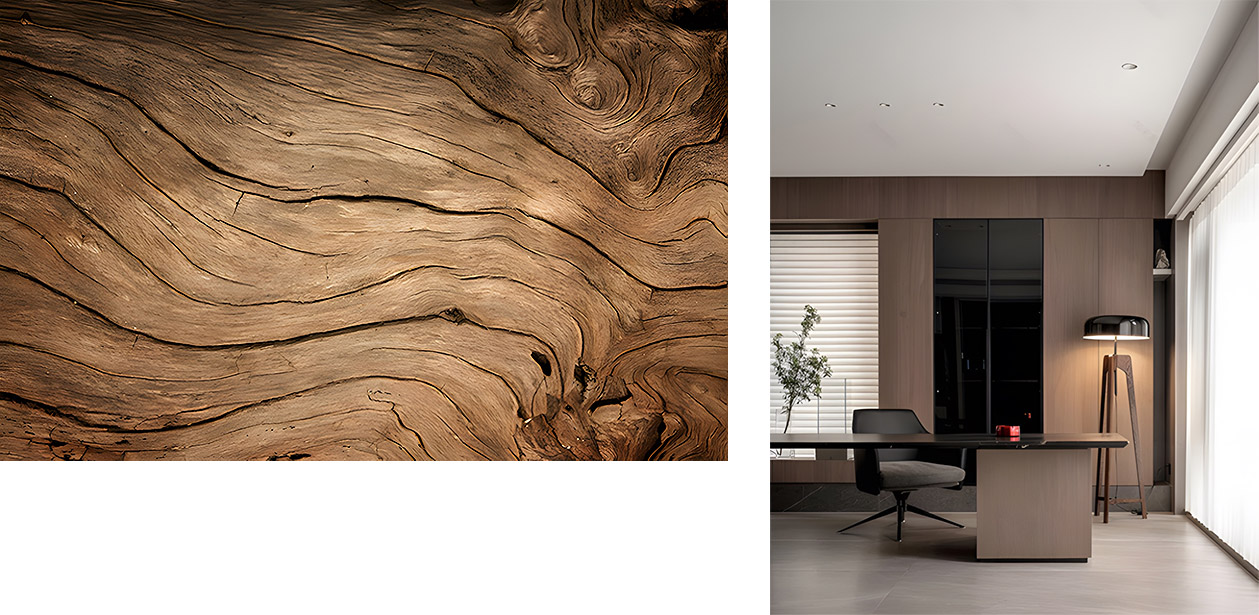
The production sequence for a painted teak veneer siding panel generally follows these stages:
- Veneer slicing: Teak logs or flitches are rotary-cut or sliced into thin veneer sheets, preserving natural grain figure.
- Surface treatment: For the 6186CS product line, a steel-brushed finishing process is applied to the solid wood surface, opening the grain texture for a distinctive tactile and visual profile.
- Substrate bonding: The finished veneer is laminated to an engineered panel substrate under heat and pressure using low-emission adhesive systems.
- Precision sizing: Panels are cut to standard dimensions (1220mm × 2440mm) and calibrated to a 3.6mm face thickness for consistent installation behavior.
- Quality & emissions testing: Panels are tested against the E0 emissions grade, the strictest tier in the common formaldehyde-emission classification system used for wood-based panel products.
Further detail on the company's production capability is available on the Produce page, and ongoing developments are posted to the News section.
4. Technical Specifications
| Product Name | 6186CS Teak Siding Panels |
| Product Series | Natural Series — Painted Wood Veneer |
| Face Material | Premium teak veneer, steel-brushed solid wood finish |
| Standard Panel Dimensions | 1220mm × 2440mm × 3.6mm |
| Emissions Grade | E0 (lowest formaldehyde-emission classification) |
| Recommended Use | Residential siding, commercial facades, accent walls, decorative cladding, interior feature walls/ceilings |
| Related Products | 6186BS Teak Decking Panels · 6186DS Premium Teak Architectural Panels |
5. Application Scenarios
Teak Siding Panels are engineered for dual-purpose use across interior and exterior contexts:
- Residential exterior siding — full facade cladding or accent bands on new-build and renovation projects.
- Commercial building facades — hospitality, retail, and office exteriors where a warm, natural material palette is specified.
- Accent walls and feature walls — both interior and exterior, often paired with metal or stone for contrast.
- Soffit and ceiling cladding — covered outdoor areas such as porches and entryways.
- Decorative cladding — feature panels in lobbies, hospitality interiors, and retail environments.
For project references and completed installations, see the Case gallery, and for finish and grain-pattern options, browse the Style catalogue. Architects working across mixed material palettes may also want to review the Art Series and Technology Series product lines for complementary panel finishes.
6. Installation Methodology
Correct installation is critical to long-term siding performance, primarily because it governs how moisture moves behind the panel. The standard assembly uses a ventilated rainscreen approach:
Figure 2: Simplified rainscreen assembly for exterior teak siding installation. Diagram is original and provided for general reference only — always follow local building codes and manufacturer installation instructions.
- Weather-resistant barrier: Install a continuous water-resistive barrier over the sheathing before any framing member is attached.
- Furring strips / ventilation gap: Vertical or horizontal furring creates an air gap behind the panel, allowing incidental moisture to drain and evaporate rather than sit against the wood.
- Fastening: Use corrosion-resistant fasteners (stainless steel or hot-dip galvanized) sized appropriately for the 3.6mm panel face and substrate thickness. Avoid over-driving fasteners, which can crack the veneer face.
- Expansion allowance: Leave manufacturer-recommended gaps at panel joints to accommodate seasonal expansion and contraction.
- Flashing and sealing: Detail all penetrations, window and door openings, and top/bottom terminations with proper flashing to direct water away from the assembly.
- Code compliance: Follow local building codes for wind load, fire rating, and rainscreen requirements specific to the project's climate zone.
7. Teak Siding vs. Other Cladding Materials
| Material | Durability | Maintenance | Aesthetic |
|---|---|---|---|
| Teak Siding Panels | Very high — natural oil & tight grain resist rot and insects | Low — periodic cleaning, occasional refinishing | Warm golden-brown, natural grain, ages gracefully |
| Vinyl Siding | Moderate — can crack in cold, fade in UV | Low | Uniform, synthetic appearance |
| Fiber Cement | High — resists fire and pests | Moderate — repainting needed over time | Can mimic wood but lacks natural grain depth |
| Untreated Softwood (e.g. Pine) | Low-moderate — prone to rot without treatment | High — regular sealing/staining required | Natural but requires ongoing upkeep |
8. Maintenance & Longevity
- Clean with a soft brush or damp cloth; avoid harsh chemical cleaners that can strip the painted veneer finish.
- Inspect exterior panels periodically for wear, and reapply a compatible protective finish if weather resistance appears to be declining.
- Where possible, reduce prolonged direct sun and moisture exposure to slow natural fading and minimize warping risk.
- Handle panels carefully during installation and cleaning to avoid surface scratches or dents.
Left unfinished, teak naturally weathers to a silvery-grey patina over time as UV exposure breaks down surface oils — a well-documented characteristic of the species used decades-long in marine and outdoor furniture applications[1][5]. Panels with a maintained protective finish retain their golden-brown tone considerably longer.
9. Sustainability & Certification
Because natural teak forests have faced pressure from unsustainable and, in some regions, illegal logging, responsible sourcing matters[1]. The Forest Stewardship Council (FSC) certifies timber and timber products harvested under defined sustainable forestry standards, and is one of the most widely recognized frameworks buyers use to verify responsibly sourced wood. Zhejiang Heyong Home Furnishing Intelligent Manufacturing Co., Ltd. holds FSC International Forest Certification alongside Green Product Certification and ISO system certification, as detailed on the company's Company Profile page.
On the manufacturing side, Teak Siding Panels are produced to the E0 emissions grade — the strictest tier in the panel-industry formaldehyde-emission classification system — supporting healthier indoor and outdoor air quality around the finished installation.
10. Frequently Asked Questions
Is teak siding suitable for coastal or high-humidity climates?
Yes. Teak's natural oil content and low shrinkage coefficient make it one of the more stable hardwoods in fluctuating humidity, which is part of why it has long been specified in marine environments[1][4].
Does teak siding need to be sealed every year?
No — teak's natural oils provide baseline protection even without added finish, though periodic inspection and reapplication of a compatible protective coating helps preserve color and surface performance over time.
What is the standard panel size for 6186CS Teak Siding Panels?
1220mm × 2440mm with a 3.6mm face thickness, manufactured to the E0 environmental emissions standard.
Can teak siding panels be used indoors as well as outdoors?
Yes — the same panel is commonly specified for interior accent walls and ceilings as well as exterior facades, siding, and cladding.
Specify Teak Siding Panels for Your Project
Zhejiang Heyong Home Furnishing Intelligent Manufacturing Co., Ltd. (MOOSOO) manufactures Teak Siding Panels and the wider Natural, Art, and Technology veneer series from its 100,000 m² production base in Jiashan County, Zhejiang Province, China.
Address: No. 129 Jinxiu Avenue, Yaozhuang Town, Jiashan County, Jiaxing City, Zhejiang Province
Phone: 0086 13957350809
Email: sales@moosoo.com.cn
View the product page: 6186CS Teak Siding Panels · Contact Us